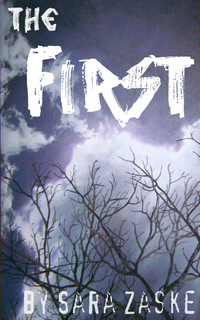
That means if you have a Nook, iPad, or a smartphone, there’s now a version of The First just for you. It has been getting great reviews, and it’s only $2.99 (such a bargain.)
Cas Lowood is a ghost hunter. He’s got a knife and an inherited power that allows him to take out the real baddies, the ghosts who kill. Following a tip, he travels a small town in Canada where he finally meets his match in a powerful ghost called, you guessed it: Anna dressed in blood.
I loved the concept of this book. It’s powerful and as gory and horrifically scary as a terrific ghost story should be. The characters, even the small ones, are unusual, and the action scenes made me grip my Kindle so hard I thought it would bleed e-ink.
I wanted to rave about this book, but I can’t, mainly because the writing was uneven. The main character’s bravado and almost pathological “smirking” was one problem.
I didn’t buy the love story. There wasn’t much reason for it that I could see; it happened too fast and didn’t make much sense. (I’ve seen a lot of this in recent YA, and I’ll write a post about the curse of the Twilight romance one of these days.)
But I protest too much—truth be told, I read this book at a feverish pace. And despite the problems, there are moments of brilliance in Anna. It’s one of those books that sticks with you even when you put it down—all of which means, there’s a helluva good story in Anna Dressed in Blood.
So if you like horror stories, pick it up. I dare you.
(It’s listed at a really low price right now: $2.99 on Kindle at least last I checked Amazon.)
As of July 16, The Firstis now available on Smashwords! And will soon be available Barnes & Noble, Diesel, Apple and many other fine ebook stores, in addition to Amazon.
To celebrate, my little YA eco-thriller and I are going on a blog tour. There will be interviews, guest posts and giveaways. So come along! Mark your calendar, visit these fabulous book blogs, and don’t forget your reading glasses!
Beatrice lives in a dystopian Chicago where everybody is assigned to a faction, according to their dominant character trait. She is in “abnegation” which is a fancy word for selflessness. At 16-years-old, all the teenagers in this world must take a test and then choose a faction. Beatrice is, let’s say, a little divided. If I say any more, I’m going to spoil it.
So OK, I’m probably the last YA book blogger on the Internet to read this book. To be honest, I thought I wouldn’t like it. Everyone hailed Divergent as another Hunger Games, and I don’t like cheap copy cats. But after about 20 pages, Divergent had me by the throat and wouldn’t let go until I finished it. Beatrice is an awesome lead character, a totally bad ass, gutsy heroine. Her flaws tend to revolve on being too bold.
Somethings annoyed me such as a pretty unbelievable premise. Why in the world would everyone divide off by their main characteristics after a huge war? Also, the way Roth named the factions with all 50-cent words felt kind of false, but I’m sure a lot of teenagers will get the words erudite and amity right on their SATs this year.
Sure, Divergent is a little like the Hunger Games: both are dystopian, deal with war and have tough heroines, but most importantly, the two books are similar in that they have something to say. While Hunger Games is very much about war,
Divergent is about how we define ourselves and what we value above all else. What, if anything, is worth killing or dying for?
I’m curious to see where Roth takes the series in Insurgent. I hope she follows Suzanne Collins lead there too and makes the next book even better than the first.
Graceling by Kim Cashore Katsa has a talent for killing people, and she’s not an evil witch or nemesis in Graceling. She’s the heroine.
Graceling is set in a typical high-fantasy world of small kingdoms with a bit of magic, a few people are born with “graces”—not all are violent, some have a swimming grace or a cooking grace. But not Katsa—she’s a stone cold bad ass. She can beat up or kill anyone, and in a world without guns, nothing can stop her.
There is something very cathartic about Graceling and its killer heroine. Can you imagine—never having to fear walking alone at night, never worry about being mugged, raped, or even just pushed around, ever.
It seems there’s a run on killer girl heroines lately: Katniss in The Hunger Games, Tris in Divergent (that review to come). I hope the trend will continue. It’s a welcome change from the wimpy I’ll-curl-up-and-die-without-my-man Bella Swan from Twilight.
Katsa is such an unapologetic powerful female character that I was a little disappointed that romance played so central a role in Graceling. But even love does not weaken Katsa. She takes her lover on her terms, and he in turn is not afraid of her power, even though she can beat him up. One of the best moments is when he says her ability humbles him. It doesn’t humiliate him.
Graceling is a very freeing fantasy, and dare I say it—a feminist one. I hope books with killer heroines will inspire girls to develop their fighting skills. And why not? If the Hunger Games can inspire an interest in archery. maybe it can inspire girls to learn to be bad ass fighters too.
Girls should know how to fight. It’s a tough world out there, and you certainly can’t wait for a knight or a love sick vampire to come save you.
So I was interviewed recently on damosays.com. Horror author and blogger Damien Kelly somehow managed to peg me as a crazy, potentially murderous hippie!
I can own up to at least one of those descriptors. OK, maybe two. . .
Henry is a faker. He helps trick Parisian nobles into buying fake swords of power, medieval knightly knock-offs, if you will, but when he tricks the wrong person, he suddenly finds himself on an all too real quest for the sword of all swords: Excalibur. You remember that one right? The one King Arthur pulled from a big rock?
The premise of The Wrong Sword would be some pretty stinky fromage if it were completely serious. But it’s not. In fact, I think its anachronistic humor is the best part. The students of Paris spout postmodern theory, at one point Henry gives a knight “A Full Merlin” by disrobing him, and the sword, well, she’s a magical pain in the butt.
The Wrong Sword delivers many laugh-out-loud moments, and the conniving Henry is more real and likeable than perhaps even King Arthur himself.
I have only a few hesitations in recommending this book (why I’ll give it 4 out of 5 stars where they do that kind of thing): not many characters are as well-developed as Henry, and the plot drags at some points even though it’s jam-packed with action—perhaps because not all the narrow escapes are believable and a few scenes are hard to follow. It felt like one more round of editing would have polished The Wrong Sword to a better shine.
That said, The Wrong Sword a really fun adventure story and a great bargain for your e-reader. It brings all the adventure of the Roundtable without any of that high-minded chivalry merde, if you’ll excuse my French.
Which reminds me—if you’ve never read any of the great King Arthur stories, here are two classics:
The Sword in the Stone by T. H. White
It’s the whole King Arthur adventure with a side order of political philosophy. “Might makes Right” any one?
.
The Mists of Avalon by Marion Zimmer Bradley
The Mists tells the whole thing from the so-called ladies’ point of view. And really Morgania (Morgan Le Fay) and Gwenhwyfar are fascinating characters in a tale that is usually a male-dominated sword-fest.
Wow. This is one terrific, terrible book! Let me explain…
Coraline is about a young girl who likes exploring and finds a hidden door to another world… so far a pretty common premise for a “children’s book,” right? But what’s behind the door is what makes Coraline so terrible: the “other mother” who unlike her real mother pays her lots of attention, cooks good food, and gives her what she wants. But also unlike her real mother, the other mother has buttons for eyes and wants to love Coraline to death.
As an adult, I love Coraline. I picked it up on a whim, and the story has haunted me for weeks with the clicking, scratching noise of the other mother’s hand, and I’m well past the 8+ recommended reading age. But for kids? It might be too terrible, in the old scary sense of the word.
Now, I know children need evil in their stories. And the other mother is like the wicked step mother from fairy tales only more evil–
The other mother embodies what every child hates and fears in their own mothers: the controlling part, the part that has the power to grant dreams and to crush them.
And Coraline (as does every child) has to defy and defeat her in order to grow up.
But my ability to see this might be because I’m out on the other side of childhood, at least for the most part I like to think. Can 8-year-olds get past the button eyes, the vicious rats, the soul-less child ghosts to a larger theme or will it just plain terrify them?
Which makes me wonder: who is the real audience for books like Coraline?
There’s been a lot of discussion about adults reading YA lit. Joel Stein touched off a firestorm saying they shouldn’t, but I say it’s good for us. Heaven knows revisiting childhood is the first thing a head shrink will tell an adult to do. And arguably every time anyone enters the world of a book, be it YA or high literature, they re-enter the child-like world of “let’s pretend.”
So go ahead adults: children’s and young adult books are for you too! But make no mistake, while it might be fun to pretend to be Katniss in The Hunger Games or the adventurous Coraline in Gaiman’s book, but really, we adults might be a bit closer to characters like the Games’ President Snow or Coraline’s terrifying other mother.
The movie is pretty good too, but the book is better. Read it first!
Must have been tough to live during the times of witch hunts, especially if you were a real live witch. That’s the essential premise of Witch Child. It’s 1659, and Mary, a young English girl, finds herself on her own and under suspicion after her grandmother’s witch trial. Then, an ever-so-helpful soul sends Mary off to the New World with the Puritans. Talk about going from the frying pan to the fire.
Anyone who has read Arthur Miller’s The Crucible knows how this story is going to go, but for some reason I couldn’t stop turning the pages. Rees is a captivating story-teller, and she’s created a strong and smart character in Mary.
Mary is certainly no Puritan pansy, just waiting for them to come for her with the ropes and the implements of torture. She’s a survivor.
The “magic” in Witch Child is understated. Don’t expect any fantabulous displays, but the more subtle approach gave the book a more realistic feel and helped drive home its messages about intolerance and cruelty.
Now, the ending ticked me off a bit because it is so open that it made me feel like this book isn’t complete in itself. I like series, but I feel a somewhat robbed when the first one isn’t a whole story in itself. So if you let Witch Child cast its spell on you, you are going to have to read the next one too: Sorceress.
*Note: the version I read came from my local library and was published in 2000. The version currently on Amazon was published in 2009.




 Henry is a faker. He helps trick Parisian nobles into buying fake swords of power, medieval knightly knock-offs, if you will, but when he tricks the wrong person, he suddenly finds himself on an all too real quest for the sword of all swords: Excalibur. You remember that one right? The one King Arthur pulled from a big rock?


 Wow. This is one terrific, terrible book! Let me explain…
 Must have been tough to live during the times of witch hunts, especially if you were a real live witch. That’s the essential premise of
 Sara Zaske